🔑 Why companies love diversification (and why it sometimes fails)
Welcome to The Business Buying Academy with Sieva Kozinsky.
🔑 Tech Optimism and the Allure (and Peril) of Diversification
In business, history always repeats itself.
Capitalism is defined by the same cycle playing out over and over:
A boom period, which creates euphoria and overexpansion, followed by a bust cycle, where everything contracts back to a more natural state.
You can see this play out across every industry over the years.
I want to highlight an example of this today.
Two companies started about 30 years apart from each other - but they followed nearly the same storyline.
The trend they both followed is tech optimism.
A new technology emerges that creates a huge opportunity - and each of the businesses I'm writing about today seized that opportunity.
Later, several new, related technologies later emerge as well.
Growing euphoric with possibility, the businesses strayed from their original mission and built a horizontal conglomerate with tentacles extending to dozens of different businesses.
Let's dive in to each one:
Litton Industries
Charles Bates “Tex” Thornton (1913–1981) was a salesman, WWII strategist, and CEO whose story perfectly captures the mid-20th-century American faith in technology, systems thinking, and endless growth through acquisition.
He lost his father young.
And he developed a deep ambition to succeed (he had to in order to survive the Great Depression).
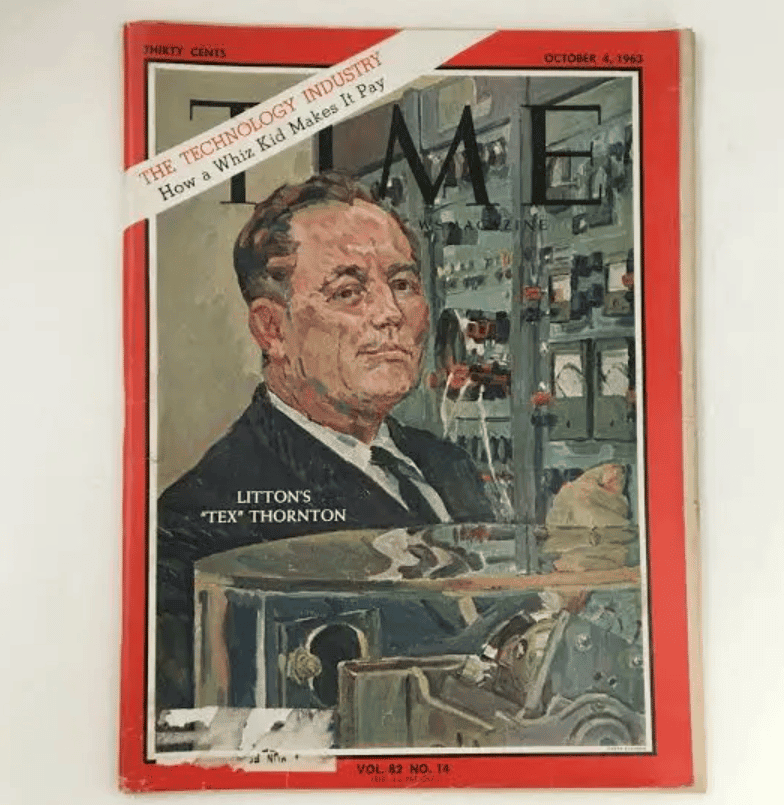
During World War II, he served as a statistical control officer in the Army Air Forces, part of an elite group (alongside future Ford president Robert McNamara) that used data and management systems to optimize bombing campaigns and logistics.
This experience convinced him that rigorous systems and “thinking big” could transform any business.
After the war, Thornton joined Ford Motor Company but soon left to pursue his own business ventures.
In 1953, he acquired a small, struggling electronics firm called Litton Industries.
They made microwave tubes and had just $3 million in annual sales.
Thornton’s vision was audacious: build a diversified technological powerhouse by acquiring companies across electronics, defense, shipbuilding, office equipment, and even consumer goods.
Tex was about to be at the forefront of the post-war expansion in the United States.
He believed synergies and accretive growth would create unstoppable momentum.
Litton exploded.
Within years, sales hit $100 million; by the mid-1960s, they reached $1 billion.
Thornton snapped up businesses like Ingalls Shipbuilding, Monroe Calculating Machine, and Royal McBee (typewriters and office gear).

The company became a poster child for the 1960s conglomerate boom.
The formula: Ride low interest rates, a postwar tech boom, and investor hunger for growth at any cost.
The Illusion of Earnings Growth - The boom was driven by "multiple arbitrage," where companies with high Price-to-Earnings (P/E) ratios used their overvalued stock to acquire firms with lower P/E ratios, creating a false impression of organic growth, as discussed in.
- Forbes
Thornton’s military-honed style (dramatic meetings, emphasis on people yet relentless expansion) embodied the era’s tech optimism: the idea that modern management science could conquer unrelated industries and deliver perpetual earnings growth.
Tex favored bold diversification into cutting-edge fields (electronics, aerospace, automation).
Wall Street loved it, bidding up Litton’s shares and fueling more acquisitions.
But cracks appeared.
In 1968, a modest earnings miss (profits per share dropped sharply) sent the stock plunging, exposing how much of the “growth” relied on accounting magic rather than operational magic.
The 1968 Crash: The meteoric rise came to an abrupt halt in January 1968. When Litton reported a quarterly profit miss (21 cents per share compared to 63 cents the previous year), the market reacted violently. The stock nearly halved overnight, falling from $120 to $53.
- Forbes
The broader conglomerate fad collapsed amid rising interest rates, antitrust scrutiny, and the realization that managing wildly different businesses was harder than the systems theorists claimed.
Litton survived but the business was later broken up and absorbed by others.
Many of the former Litton divisions still exist today with new owners. But the original vision of the conglomerate didn't come to fruition.
Let's fast forward a few decades to see nearly the same story play out.
Level 3 Communications was founded in 1997 by James Crowe, an experienced operator. It went public just a year after founding, highlighting how quickly they moved to capitalized on the internet trend.
The business focused on building a nationwide, all-fiber IP-based network from the ground up, targeting the anticipated explosion in internet and data traffic.
Key Early Acquisitions for Network Expansion (1998–2000):
- Acquired XCOM Technologies and other smaller fiber startups to accelerate metro and long-haul network deployment.
- Purchased rights to dark fiber and infrastructure assets from various utilities and carriers to rapidly scale its footprint without solely relying on organic construction.
- Expanded internationally through acquisitions and joint ventures for European and Asian connectivity.
Then they diversified.
This was the peak of the Dot Com Bubble, and hot internet-related companies were awash in capital to fund whatever dream they wanted.
Major diversifying deals included:
- Acquired Genuity Inc, gaining additional enterprise services and internet backbone capacity.
- Broadwing Communications (2003), a $3 billion deal that gave Level 3 significant fiber routes, voice services, and enterprise customers, diversifying beyond pure wholesale data into more integrated telecom offerings.
- Smaller tuck-in acquisitions of regional carriers, colocation facilities, and VoIP/data service providers to add customers, metropolitan networks, and adjacent services.
The overall strategy mirrored Litton: acquire disparate tech-adjacent assets (fiber, voice, internet services) assuming synergies from converging digital networks would drive explosive growth in data, internet, and enterprise traffic.
How the Strategy Played Out
- Boom Phase (Late 1990s–Early 2000s): The company became a Wall Street darling during the telecom/internet bubble. Its stock soared on hype around unlimited bandwidth demand and “converged” IP networks replacing traditional voice infrastructure. Acquisitions helped Level 3 quickly gain scale, customers, and geographic reach, positioning it as a leading facilities-based provider for wholesale carriers, enterprises, and internet traffic.
- Bust and Overcapacity (2001–2005): The dot-com collapse and telecom downturn revealed massive overbuilding across the industry. Internet traffic grew rapidly but not at the hyperbolic rates forecast, leading to fierce price competition and dark fiber glut. Level 3 faced huge debt loads from builds and acquisitions, plunging revenues per unit, and operational integration challenges, much like Litton’s earnings reality check in the late 1960s. The company avoided immediate bankruptcy but underwent massive restructuring, layoffs, and asset write-downs.
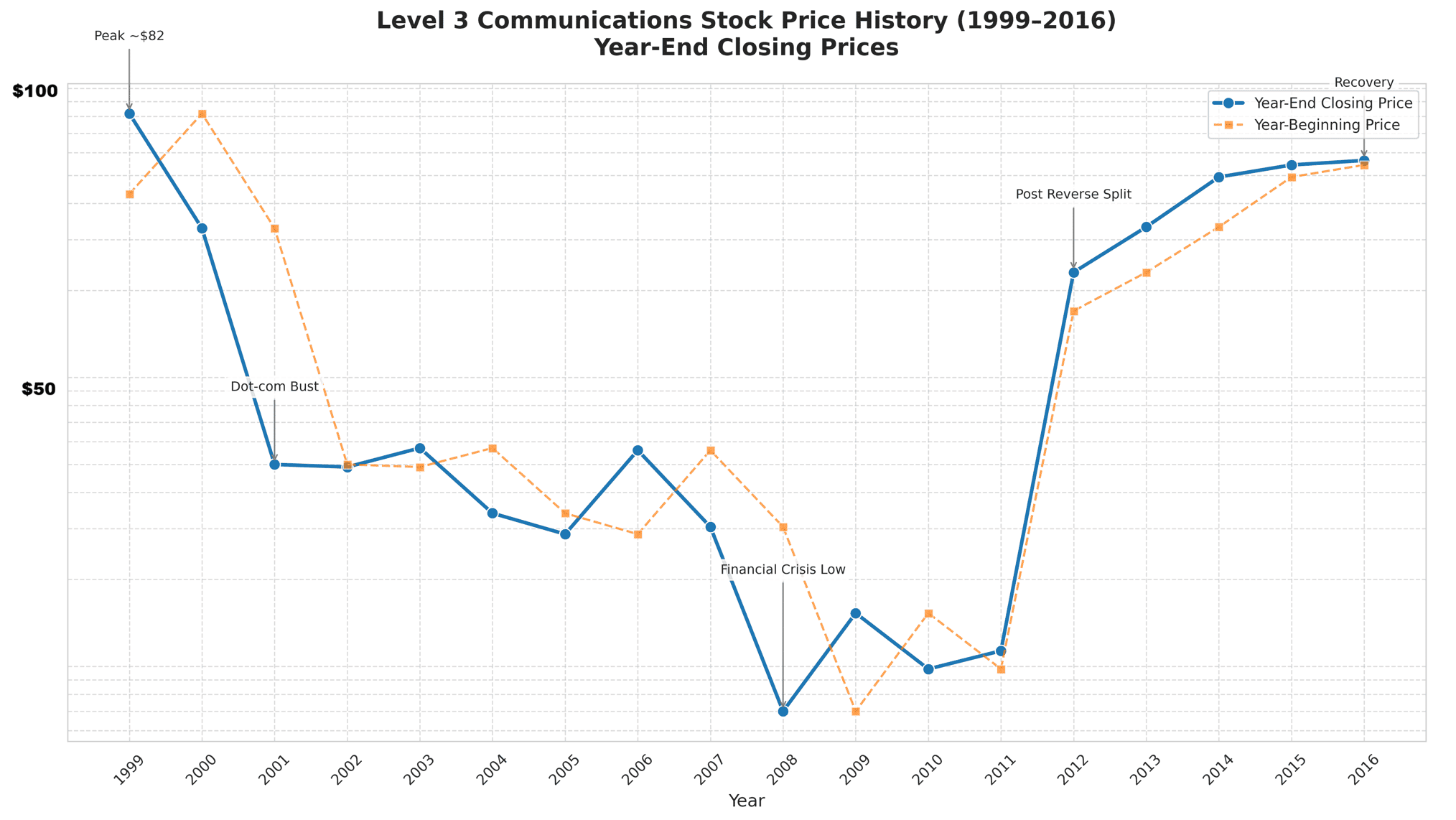
- Longer-Term Outcome (2000s–2010s): Level 3 survived by focusing on enterprise services, content delivery, and wholesale data, becoming a more disciplined player. It eventually merged with CenturyLink (now Lumen Technologies) in a $34 billion deal completed in 2017. While the original high-growth diversification vision did not fully materialize, the core fiber network proved strategically valuable in the long run for cloud, 5G backhaul, and data demands decades later.
Sieva
P.S. - Are you hiring? Get started with top global talent from Somewhere (I'm a customer and investor)
Disclaimer: nothing here is investment advice. Please do your own research. The information above is just for information and learning.

.jpg)