🔑 Buying a local trailer business and turning it into a $4 billion business
Welcome to The Business Buying Academy with Sieva Kozinsky.
🔑 They kept buying niche businesses. Now their company is worth $4 billion.
In August 1980, two ambitious entrepreneurs made one of the coolest acquisitions I've ever seen.
Wade Thompson and Peter Orthwein acquired the struggling, but iconic, Airstream travel trailer brand from Beatrice Foods (yes, the dairy company owned a travel trailer business).
Beatrice had to unload the business amid a recession.
Trailers were outside their core area of expertise, so they divested from it.
Thompson and Orthwein got the benefit of buying a great brand at a discount.
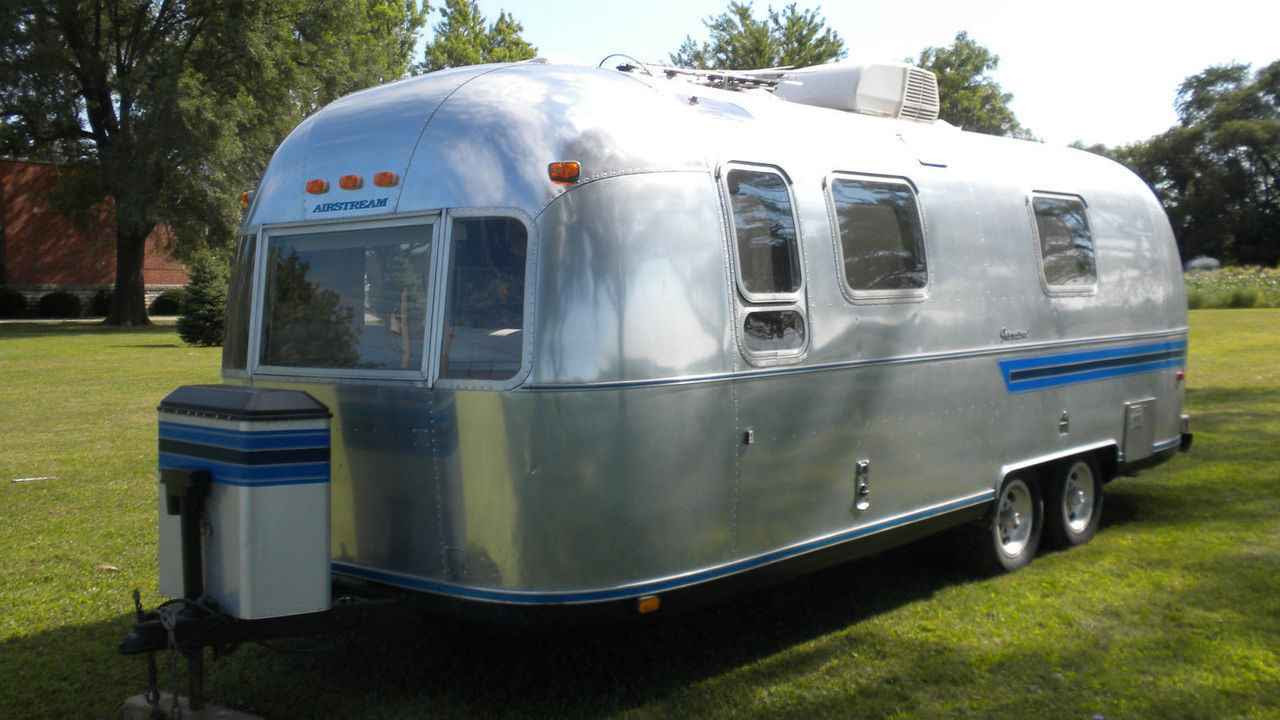
They set out to do what every turnaround acquisition starts with: improving quality, cutting costs, and restoring profitability.
They succeeded.
But this deal soon transformed into something much bigger:
The creation of THOR Industries.
Named by combining parts of the founders’ last names, the company became a decades-long game of strategic acquisitions. In a couple decades, they went from a niche RV company to the world’s largest manufacturer of recreational vehicles.
But before forming THOR, Thompson and Orthwein (who met at a business lunch in 1976) made their first acquisition on a smaller scale.
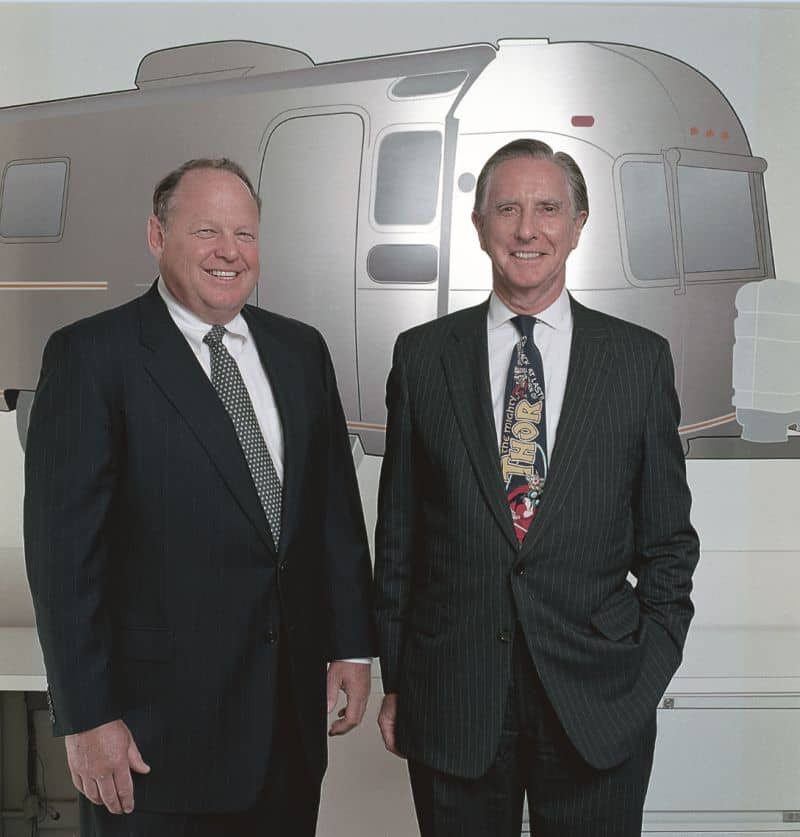
They bought Hi-Lo Trailer Company, a small Ohio maker of travel trailers.
The acquisition price was just under $1 million. At the time, the travel trailer business was hated by investors. Gas prices were skyrocketing and it seemed like no one was traveling.
Orthwein later recalled:
“Neither of us knew anything about recreational vehicles. But the company had a bunch of cash on its balance sheet and assets we could borrow against.”
Thompson commuted weekly from New York City, living in a modest one-room apartment above a pizza parlor in Butler, Ohio (population ~921), with a single light bulb in the kitchen.
He “put his last dime into" the business.
This deal gave them their first operational experience and set the stage for bigger things.
Four years later, that bigger thing arrived.
Airstream, the “crown jewel” of the industry with its iconic aluminum trailers, had lost $12 million the prior year under Beatrice Foods ownership during fuel crises and recession.
Thompson and Orthwein bought it for roughly $7.5 million (much of it seller-financed/borrowed).
Thompson, a detail-oriented leader with a background in mergers and acquisitions, flew in weekly to oversee operations in Jackson Center, Ohio.
He famously handed out black pens to employees, declaring, “There isn’t going to be any more red ink at this company.”
They focused on quality improvements, cost cuts, dealer relations, and product reconfiguration, without mass layoffs.
The result: A $13 million turnaround in the first year, shifting from heavy losses to ~$1 million in profit. Thompson later explained his entrepreneurial drive:
“It was an understandable industry. Even though I knew nothing about RVs, it was a deal that could start me off as an entrepreneur. If I stubbed my toe... my family would go broke, and I’d have to go get another job.”
After acquiring Airstream and stabilizing it, they got to work on expanding.
Later acquisitions included:
- 1982: Acquisition of Canadian manufacturer General Coach (travel trailers and fifth wheels).
- 1984: Went public on the over-the-counter market.
- 1986: Listed on the New York Stock Exchange (NYSE: THO).
- Entered the bus segment (small and mid-size) with acquisitions like ElDorado Bus (1988) and National Coach (1991).
- Acquired additional RV brands, like Dutchmen (1991), Four Winds (1992), and Komfort (1995).
It eventually exited the bus business in 2013 (that segment had $450 million in annual sales) to sharpen focus on its core RV segment.
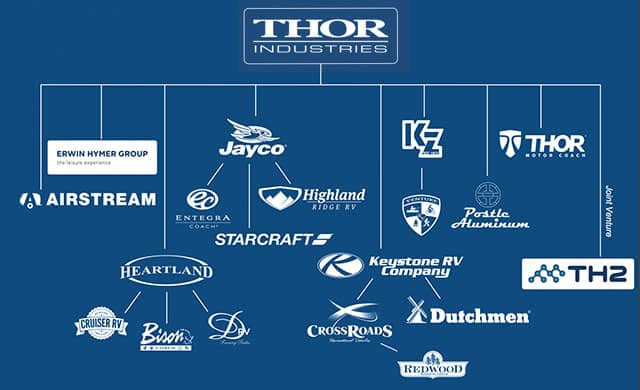
THOR used a deliberate acquisition strategy in a historically fragmented industry. Deals include:
- 2001: Acquisition of Keystone RV, a deal that gave THOR dominant scale in towable RVs.
- 2010: Purchase of Heartland RV (its largest acquisition at the time).
- 2016: Acquisition of Jayco (including Starcraft, Highland Ridge, and Entegra Coach) added major volume and popular brands like the top-selling Jay Flight.
- 2019: Bought Erwin Hymer Group (EHG) for approximately $2.45 billion, the largest deal in company history. This brought leading European RV brands and manufacturing, making THOR a true global player with strong positions in both North America and Europe.
- 2020–2021: Acquisitions of the Tiffin Group (premium luxury motorized RVs) and Airxcel (RV parts, accessories, and aftermarket products, expanding into non-vehicle revenue).
Subsidiaries generally retain significant autonomy in product development and dealer relationships.
Here's how their revenue splits between the different segments:
- North American Towable (40%): Travel trailers, fifth wheels, toy haulers (brands include Airstream towables, Jayco, Keystone, Heartland, KZ).
- North American Motorized (23%): Class A, B, and C motorhomes (Airstream is included in this)
- European Recreational Vehicles (32%): Motorhomes, caravans, and camper vans.
- Other (5%): Parts, accessories, and aftermarket products.
Financials
- FY2025: Revenue $9.58 billion (down 4.6% from $10.04 billion in FY2024).
- Net income = $259 million (down ~2.5%).
- FY2024: Revenue $10.04 billion.
- FY2023: Revenue $11.12 billion.
- FY2022: Peak revenue of approximately $16.31 billion during strong demand.
- TTM revenue: $9.9 billion
Sieva