🔑 A business buying strategy that made $3.7 billion
Welcome to The Business Buying Academy with Sieva Kozinsky. Here's what we have in store for you today:
- They bought a struggling company's best asset - and made billions
- How to roll up software businesses (and more)
🔑 Turning a $2.3 billion investment into $6 billion+
Corporate carve-outs can be great opportunities for buyers.
Today we're going to look at a classic example of one.
A "carve-out strategy" is when a parent company strategically separates a part of its business (a division or subsidiary) to operate independently, often through an IPO, sale, or spin-off, to unlock hidden value, let the parent focus on core activities, or allow the new entity to thrive on its own.
This deal happened just prior to the 2008 Great Recession.
That might sound like a gloomy warning.
But don't worry, it has a positive ending for the investors.
In 2005, Ford Motor Company wanted to divest non-core assets amid its own financial struggles.
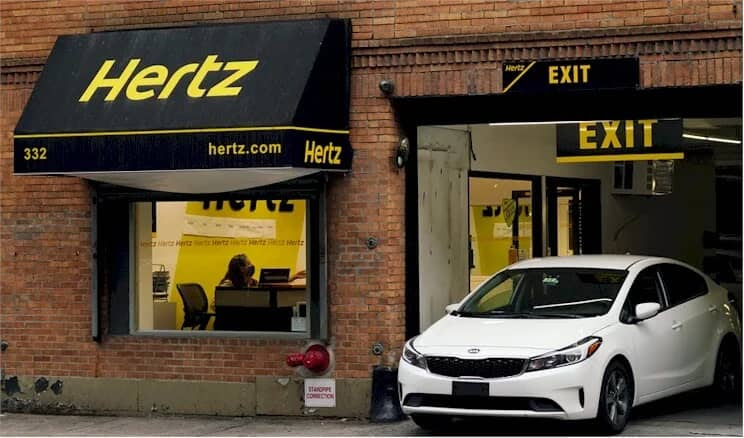
They put Hertz Corporation, the world's largest car rental company, up for sale.
They considered spinning Hertz off into an IPO, or selling it off to a separate business (whichever would net them more - Ford needed cash).
Ultimately, a group of private equity investors came together to buy Hertz and take it private.
What did they like about the deal?
Well, a lot.
There was actually an intense bidding war over Hertz.
Many viewed it as a good business being dragged down by its struggling owner, Ford.
As a standalone business, Hertz would be much better off. With a few small adjustments, investors could make a fortune.
The Business
Hertz operated in over 150 countries with two main segments:
- Hertz Rent-A-Car (RAC)
- Hertz Equipment Rental Corporation (HERC).
For 2004, Hertz reported $6.7 billion in revenue and $930 million in EBITDA, with strong cash flows from corporate contracts (about 40% of revenue).
Ford, the nation’s second-biggest automaker, said it will sell all shares of common stock in Hertz, its wholly owned subsidiary, to a private equity group composed of Clayton Dubilier & Rice, The Carlyle Group and Merrill Lynch Global Private Equity in a deal valued at about $15 billion, including debt.
Ford announced in April it was considering shedding Hertz, which it has owned since 1994, to concentrate on its core automotive business. The infusion of cash should help the automaker, which has been struggling with falling sport utility vehicle sales, growing U.S. health care costs and other issues. Ford’s second-quarter profit fell 19 percent to $946 million.
- NBC News, September 8, 2005
The Acquisition
- Announcement: September 12, 2005; closed December 21, 2005, after regulatory approvals.
- Target: The Hertz Corporation (from Ford Motor Company).
- Acquirer: Consortium of CD&R, Carlyle, and Merrill Lynch Global Private Equity.
- Enterprise Value: $15 billion (second-largest LBO at the time, behind only RJR Nabisco).
- Equity Value: $5.6 billion.
Deal Structure & Financing
The transaction was a classic LBO with high leverage, reflecting the 2005-2007 boom era:
- Equity Contribution: $2.3 billion total (15.3% of enterprise value), split as CD&R 35% ($805 million), Carlyle 35% ($805 million), Merrill Lynch 30% ($690 million).
- Debt: $5.6 billion in corporate debt (6.0x EBITDA) plus $7.1 billion in vehicle fleet financing.
- Special Financing: Included a groundbreaking $4.3 billion asset-backed securitization (ABS) for vehicle financing, led by Lehman Brothers, Deutsche Bank, JPMorgan, Merrill Lynch, and Goldman Sachs, the largest ABS of its kind at the time.
Turnaround & Operational Improvements
Post-acquisition, the investor group focused on operational excellence under new leadership. Key strategies included:
- Cost reductions of $170 million in the first year through efficiency gains; fleet utilization rose from 74% to 79% within six months.
- Divestiture of non-core real estate for $230 million.
- A $1 billion dividend recapitalization in June 2006 via additional debt.
- During the 2007-2009 financial crisis: Further $500+ million in expenses, 15% fleet reduction, and opportunistic share repurchases at low prices.
- Long-term growth: Acquired Dollar Thrifty in 2012 for $2.3 billion after a multi-year bidding process, boosting U.S. market share from 22% to 34% with $160 million in annual synergies.
Results & Aftermath
The deal proved resilient despite the Great Recession and later challenges:
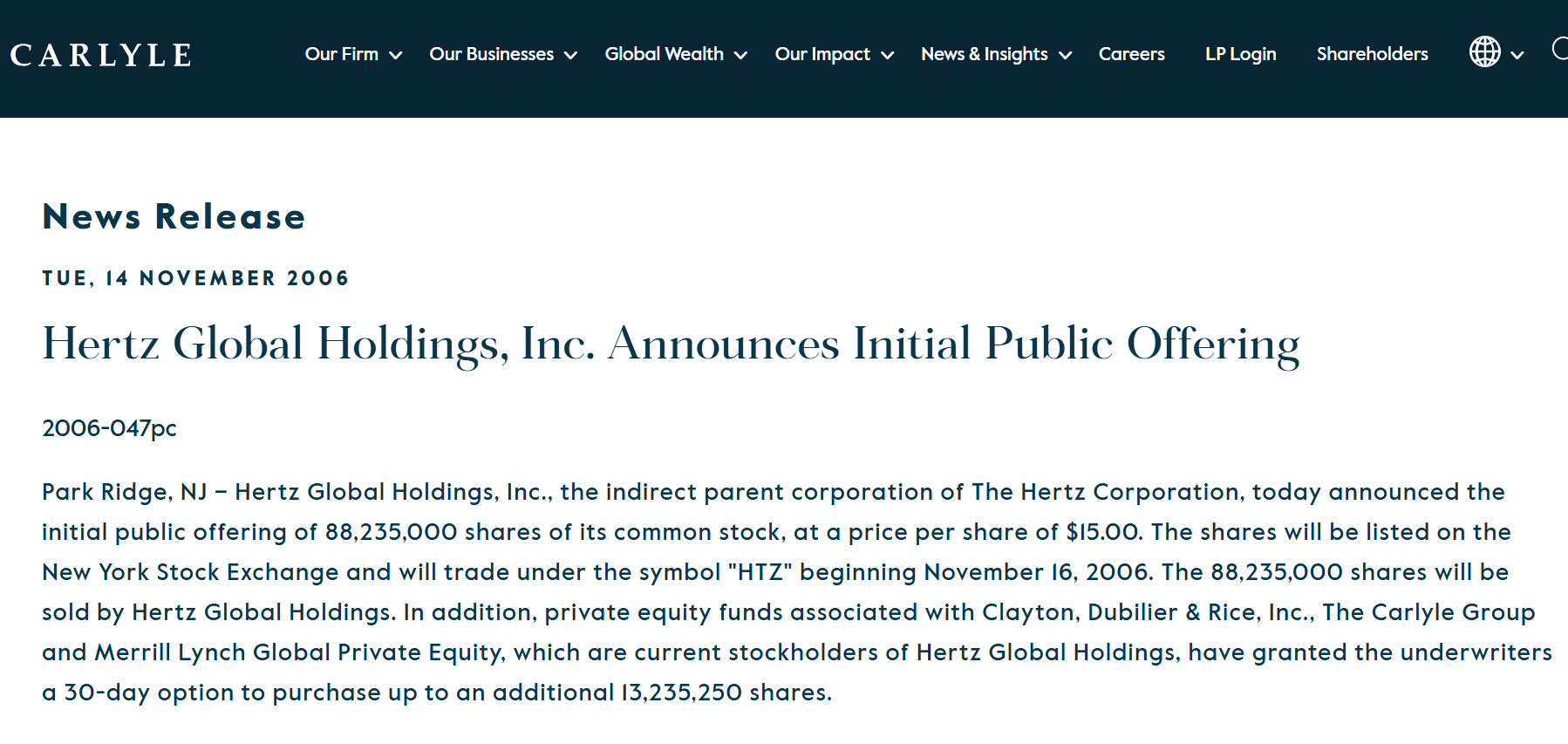
- IPO: November 2006, raising $1.32 billion at $15/share (valuing equity at $4.5 billion); sponsors retained 72% ownership and received a $427 million dividend.
- Exits: Multiple secondary offerings (e.g., $1.2 billion in Dec 2006, $1.0 billion in Jun 2007, $750 million in Feb 2011); final exit in May 2013 for $1.24 billion.
- Returns: Sponsors recouped their $2.3 billion equity (and then some):
- CD&R achieved a 2.8x multiple and 33% IRR over 7.5 years
- The overall consortium generated ~$3.7 billion in profits
Much later, Hertz filed for bankruptcy in 2020 due to COVID-19 but emerged under new ownership. But by then, investors in the 2005 had long exited. Their 2005 LBO of Hertz is still hailed as a success for PE value creation.
Key Takeaway for Buyers
Great assets like Hertz can weather economic storms if bought with operational upside in mind. The investors' focus on cost discipline and being ready to acquire competitors during a down cycle in the industry made the investment a homerun.
🔑 PE is buying again
Private equity is buying companies again after a slow couple of years.
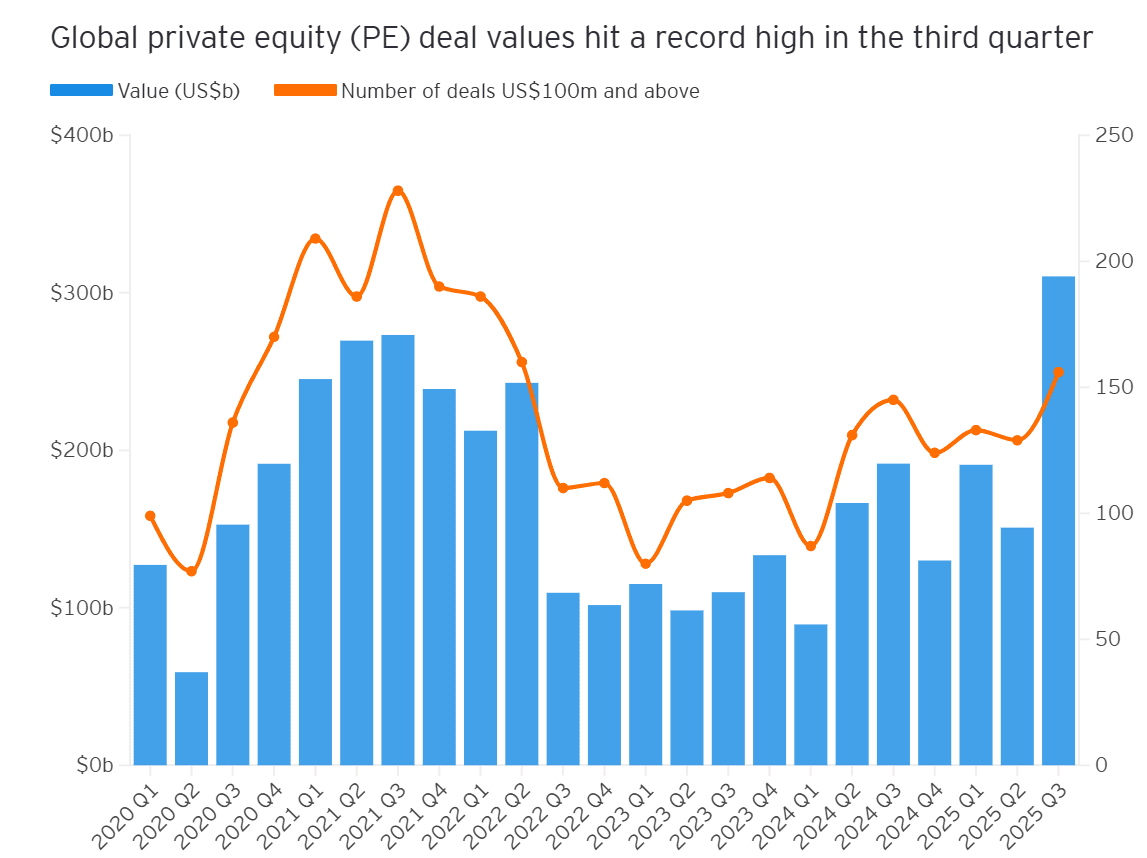
While the total dollar value of deals done by PE in Q3 of this year hit a record high of $310 billion, the quantity of deals was lower than in 2020-21.
PE is doing more blockbuster deals, but fewer deals overall.
"With private equity firms announcing 156 deals worth a quarterly high of $310B-driven by five $10B+ megadeals-the market is shifting toward consolidation...GPs are prioritizing scale over volume in a "risk-on" environment."
That's just one insight I found in this Q3 Private Equity report. Give it a read if you have a chance.
🔑 I talked to 20+ Business Buyers. They told me exactly how they bought their companies.
If you've read this newsletter for any amount of time, you know I'm obsessed with buying businesses.
And I love talking to others who have bought companies.
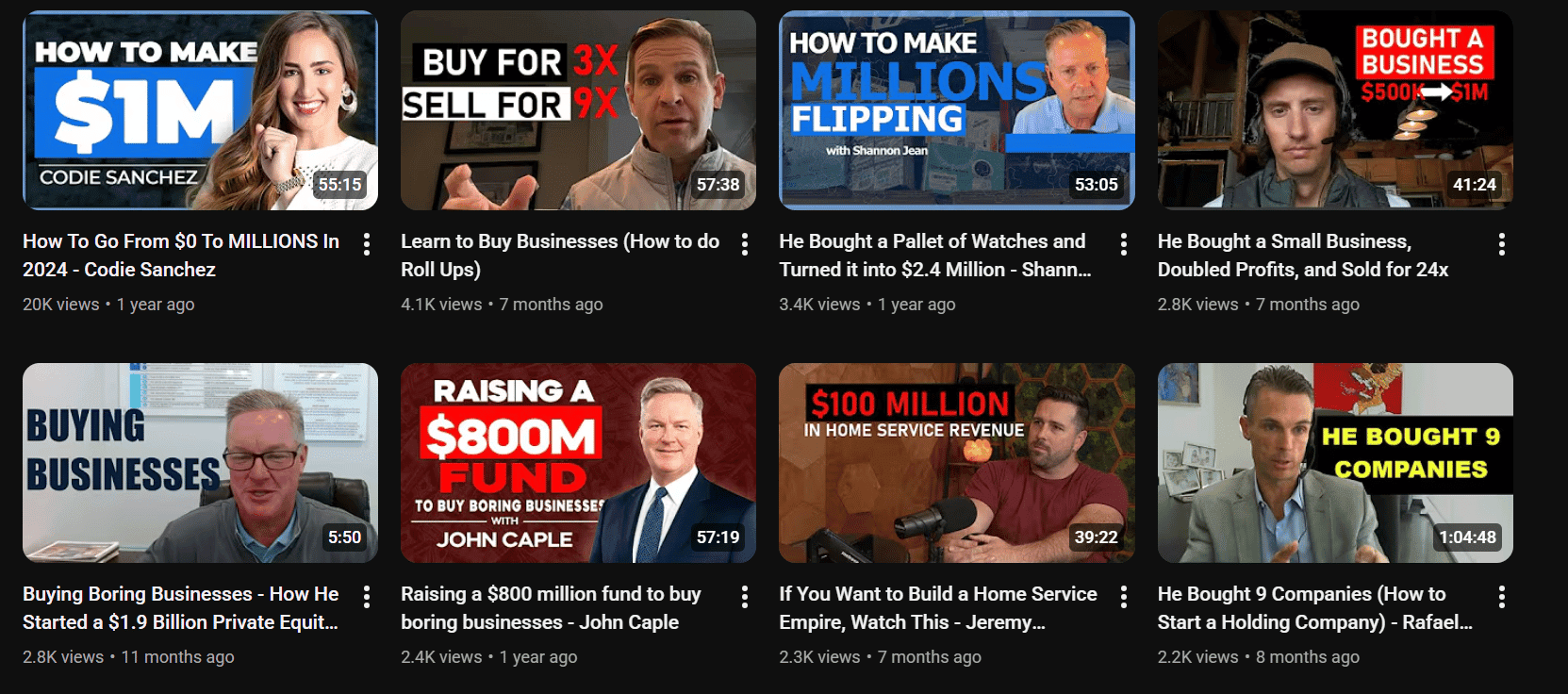
I've recorded dozens of conversations with some of the best business buyers I know - and I've put them all online for you to listen to.
There are hundreds of years of lessons on business buying for you to absorb.
Ranging from a $1 million accounting firm to $100 million hotels, we've got a bit of everything.
We've got self-funded searchers, private equity partners with billions under management, and horizontal holding company owners who buy a new business every month.
My goal: Assemble the greatest collection of business buying lessons from people who have really done it.
No matter what type of business you're looking to buy, I probably have a story for you. Check out the interviews below.
Have a great day,
Sieva
P.S. - Are you hiring? Get started with top global talent from Somewhere (I'm a customer and investor)
Disclaimer: nothing here is investment advice. Please do your own research. The information above is just for information and learning.


